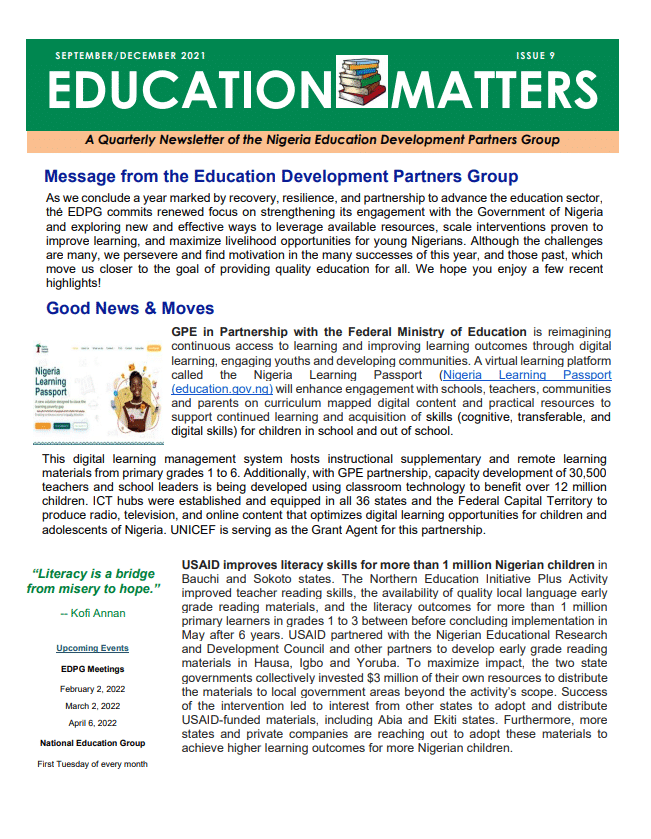


Message from the Education Development Partners Group
As we conclude a year marked by recovery, resilience, and partnership to advance the education sector, the EDPG commits renewed focus on strengthening its engagement with the Government of Nigeria and exploring new and effective ways to leverage available resources, scale interventions proven to improve learning, and maximize livelihood opportunities for young Nigerians.
Although the challenges are many, we persevere and find motivation in the many successes of this year, and those past, which move us closer to the goal of providing quality education for all. We hope you enjoy a few recent highlights!
Good News & Moves
GPE in Partnership with the Federal Ministry of Education is reimagining continuous access to learning and improving learning outcomes through digital learning, engaging youths and developing communities. A virtual learning platform called the Nigeria Learning Passport (Nigeria Learning Passport (education.gov.ng)) will enhance engagement with schools, teachers, communities and parents on curriculum mapped digital content and practical resources to support continued learning and acquisition of skills (cognitive, transferable, and digital skills) for children in school and out of school.
This digital learning management system hosts instructional supplementary and remote learning materials from primary grades 1 to 6. Additionally, with GPE partnership, capacity development of 30,500 teachers and school leaders is being developed using classroom technology to benefit over 12 million children. ICT hubs were established and equipped in all 36 states and the Federal Capital Territory to produce radio, television, and online content that optimizes digital learning opportunities for children and adolescents of Nigeria. UNICEF is serving as the Grant Agent for this partnership.
USAID improves literacy skills for more than 1 million Nigerian children in Bauchi and Sokoto states. The Northern Education Initiative Plus Activity improved teacher reading skills, the availability of quality local language early grade reading materials, and the literacy outcomes for more than 1 million primary learners in grades 1 to 3 between before concluding implementation in May after 6 years.
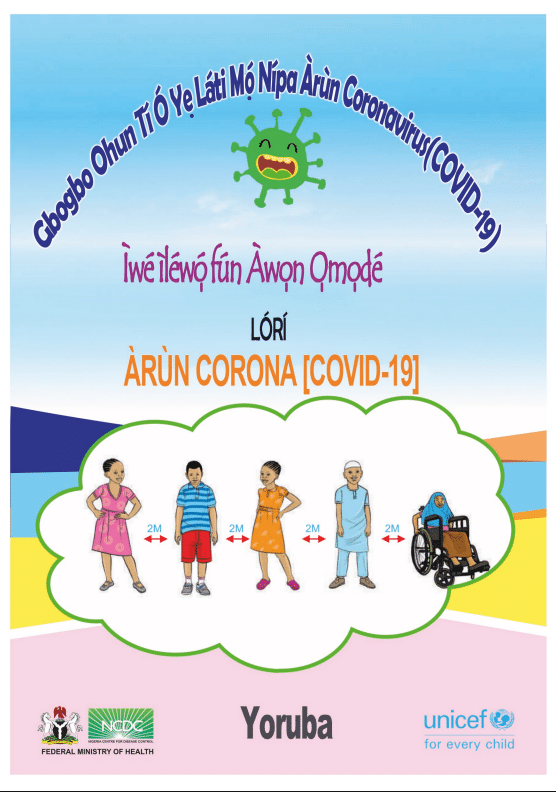
USAID partnered with the Nigerian Educational Research and Development Council and other partners to develop early grade reading materials in Hausa, Igbo and Yoruba. To maximize impact, the two state governments collectively invested $3 million of their own resources to distribute the materials to local government areas beyond the activity’s scope.
Success of the intervention led to interest from other states to adopt and distribute USAID-funded materials, including Abia and Ekiti states. Furthermore, more states and private companies are reaching out to adopt these materials to achieve higher learning outcomes for more Nigerian children.