


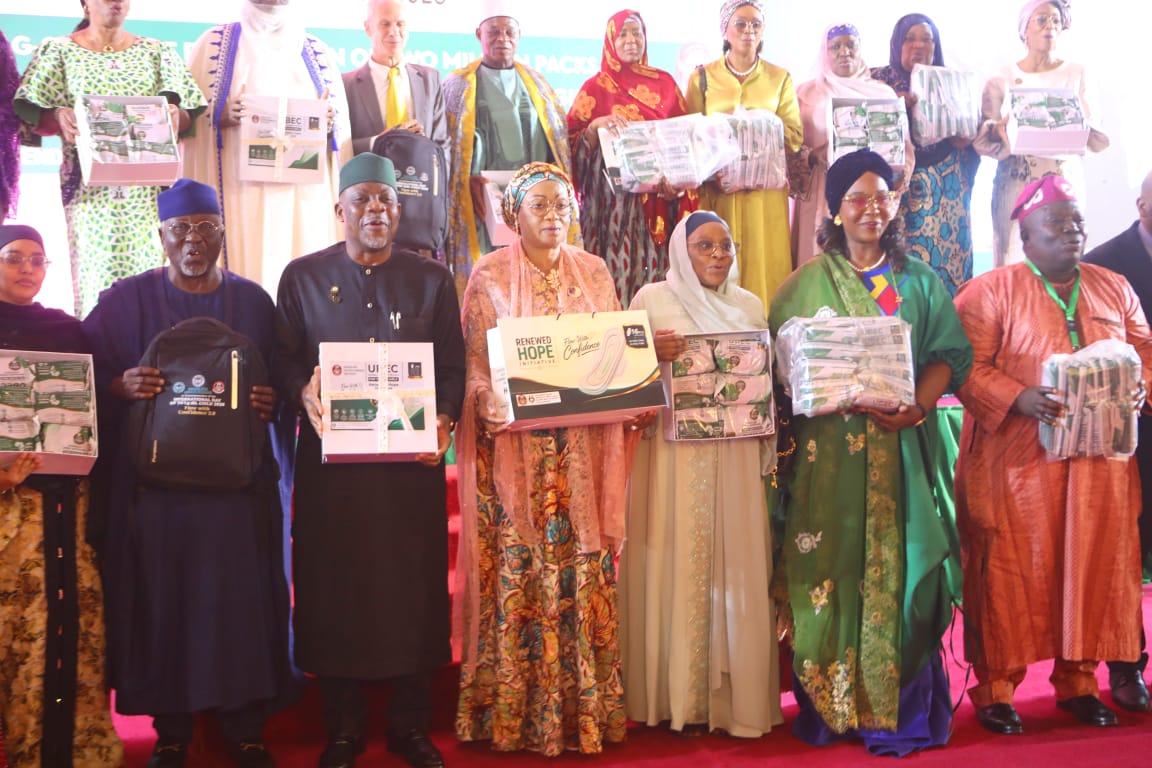
The Federal Government has flagged off the distribution of two million packs of sanitary towels and back-
to-school learning materials to girls in public basic education schools across the 36 states and the Federal
Capital Territory (FCT), strengthening efforts to promote menstrual health, improve school attendance
and keep girls in school.
The initiative, Flow with confidence, keeping every Girl in School, was launched on Monday, 12 October
2026, by the First Lady, Senator Oluremi Tinubu, CON, at the State House Banquet Hall, Presidential Villa,
Abuja, to commemorate the 2026 International Day of the Girl Child, themed “End Child Marriage and
Invest in Girls’ Rights.”
The intervention reflects the commitment of President Bola Ahmed Tinubu’s administration, through the
Federal Ministry of Education, led by the Honourable Minister of Education, Dr. Maruf Tunji Alausa, CON,
to removing barriers to learning and ensuring that every Nigerian girl can complete her education with
dignity and confidence.
The First Lady commended the Ministry and the Universal Basic Education Commission (UBEC) for
expanding the programme and integrating it into the basic education system. She recalled that the original
initiative, launched through the Renewed Hope Initiative on 2 October 2025, provided a one-year supply
of sanitary pads to over 370,000 schoolgirls in rural communities nationwide.
Senator Tinubu stressed that inadequate access to sanitary products disproportionately affects girls in
rural communities, contributing to absenteeism and threatening educational retention. She also
highlighted UBEC’s Learners’ Retention Support Programme, which plans to support 100,000 learners in
its first phase with grants of ₦20,000 each, under a ₦2 billion allocation.
She urged state First Ladies, commissioners for education, SUBEB chairmen, traditional and religious
leaders, parents and communities to ensure transparent distribution and eliminate menstrual stigma. She
encouraged girls to remain in school, believe in themselves and pursue their aspirations.
Speaking at the ceremony,
1Dr. Alausa described the initiative as a significant investment in the dignity, well-being and educational
future of Nigerian girls. He commended President Tinubu for prioritising children in national development
and applauded the First Lady’s sustained advocacy for girls’ education.
The Minister disclosed that the Ministry was institutionalising the programme through UBEC and the
World Bank-supported Adolescent Girls Initiative for Learning and Empowerment (AGILE) project. UBEC
will make annual budgetary provisions for sanitary towels, while the AGILE project will sustain menstrual
hygiene interventions throughout its implementation.
Beneficiaries will receive sanitary towels alongside school bags, shoes, exercise books, mathematics
textbooks and writing materials. Dr. Alausa commended UBEC Executive Secretary, Dr. Aisha Garba, and
her team, urging state governments and education authorities to ensure accountability and delivery to
intended beneficiaries.
The Minister of State for Education, Professor Suwaiba Sa’id Ahmad, described the intervention as a
demonstration of the government’s commitment to protecting girls’ rights and dignity. She emphasised
that no girl should choose between education and menstrual health, urging beneficiaries to remain
focused and confident in achieving their educational goals.
Earlier, Dr. Garba reaffirmed UBEC’s commitment to removing barriers to girls’ education. She disclosed
that the Commission had facilitated the construction of over 4,000 classrooms in less than three years,
alongside water and sanitation facilities, learning materials, teacher development and digital technology
in public schools.
She added that over three million pupils received back-to-school materials in the preceding year, while
approximately 700,000 out-of-school children had been supported in returning to classrooms through
interventions involving UBEC and other stakeholders.
The Chairman of the UBEC Governing Board, Senator Umaru Tanko Al-Makura, pledged effective oversight
to ensure that materials reached beneficiaries. He stressed that keeping girls in school was essential to
preventing early marriage, expanding opportunities and empowering them to shape their futures.
The Federal Ministry of Education reaffirmed its commitment to working with UBEC, state governments,
SUBEBs, development partners and communities to sustain the initiative and ensure that poverty,
menstrual hygiene challenges and other preventable barriers do not deny Nigerian girls quality basic
education.