


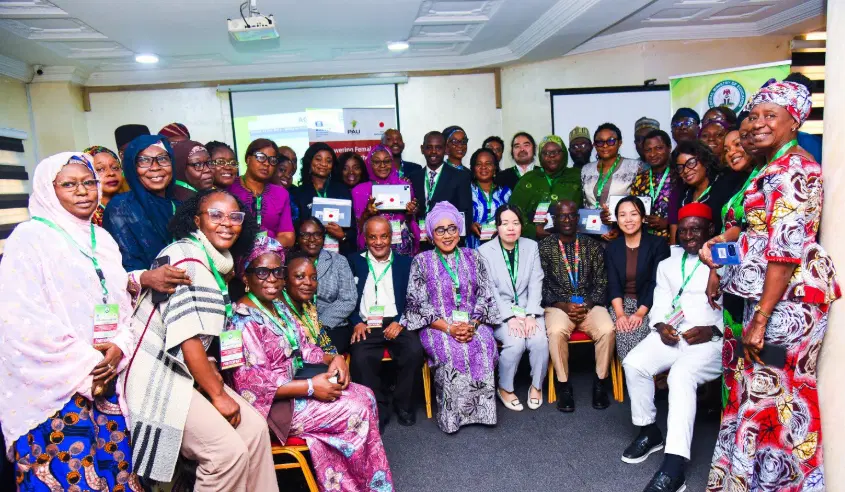
The Federal Government has intensified efforts to strengthen teacher professional development and accelerate digital transformation in education with the commencement of a three-day Master Training Workshop designed to equip master trainers with mobile-based learning skills that will reach at least 2,000 teachers and school leaders across Nigeria, with a special focus on empowering female educators.
The workshop, organised by the Federal Ministry of Education in partnership with the Government of Japan, the United Nations Educational, Scientific and Cultural Organization International Institute for Capacity Building in Africa (UNESCO-IICBA), the Pan-African University (PAU) and Castalia Co. Ltd. under the Pan-African Virtual and Electronic University (PAVEU) Initiative, seeks to expand teachers’ digital competencies and improve access to continuous professional development through mobile technology.
Declaring the workshop open, the Honourable Minister of State for Education, Professor Suwaiba Sa’id Ahmad, represented by the Director, Colleges of Education Department, Dr. Uchenna Uba, described the initiative as a major milestone in strengthening teacher education and improving learning outcomes through innovation and technology.
She said the programme aligns with the Nigeria Education Sector Renewal Initiative (NESRI), the flagship education reform under the Renewed Hope Agenda of President Bola Ahmed Tinubu, GCFR, and the leadership of the Honourable Minister of Education, Dr. Maruf Olatunji Alausa, CON, which prioritises improved learning outcomes, equitable access to quality education, teacher development, innovation and digital transformation.
Professor Ahmad noted that continuous professional development remains critical to improving education quality, adding that mobile learning platforms provide flexible, cost-effective and learner-centred opportunities that enable teachers, particularly those in rural and underserved communities, to acquire new skills regardless of location.
She emphasised that empowering female teachers and school leaders would strengthen leadership, promote inclusion and improve education outcomes nationwide.
Participants will receive practical training in digital literacy, the GOKU Mobile Learning Platform, Artificial Intelligence in Education, digital inclusion, gender-responsive pedagogy, learner-centred instructional strategies, mental health and psychosocial support, collaborative professional learning and other emerging global trends. She urged participants to cascade the knowledge acquired to fellow educators across the country.
In her welcome address, Dr. Uba, represented by Dr. Mrs Claris Ujam, described the initiative as an innovative response to barriers limiting access to professional development, stressing that teacher quality remains the most important school-based factor influencing learning outcomes. She noted that the project targets at least 2,000 teachers and school leaders nationwide.
Speaking on behalf of the Government of Japan, Ms. Akiko Miyazawa, Attaché for Development Cooperation, disclosed that Japan is investing approximately US$1 million in the initiative as part of its commitment to human capital development in Africa and the priorities of TICAD 9. She urged participants to become agents of change by transferring the knowledge acquired to educators across Nigeria.
Representing UNESCO Abuja, Mr. Adeyemi Oladeji, Acting Officer-in-Charge of the Education Sector, reaffirmed UNESCO’s commitment to supporting Nigeria’s teacher development agenda, stressing that technology and Artificial Intelligence should empower rather than replace teachers. He called for sustained partnerships and effective knowledge transfer to maximise the impact of the initiative.
Earlier, the National Focal Point for the UNESCO-IICBA Joint Project, Mrs. Mopelola Lawani, said participants would acquire the technical, practical and leadership competencies required to serve as master trainers and develop action plans to ensure measurable nationwide impact.
To support implementation, the Government of Japan, UNESCO-IICBA and the Pan-African University presented 40 tablets and two edge computing devices to participants to facilitate digital learning and the nationwide rollout of the mobile learning programme.
The Federal Ministry of Education reaffirmed its commitment to strengthening teacher professional development through strategic partnerships, digital innovation and evidence-based reforms to deliver inclusive, equitable and quality education for every Nigerian child.
Photo Credit: Vanguard